MP Materials NdPr Sales Jump 127% as Price Support Bolsters EBITDA
MiningOct 9, 2026
United States
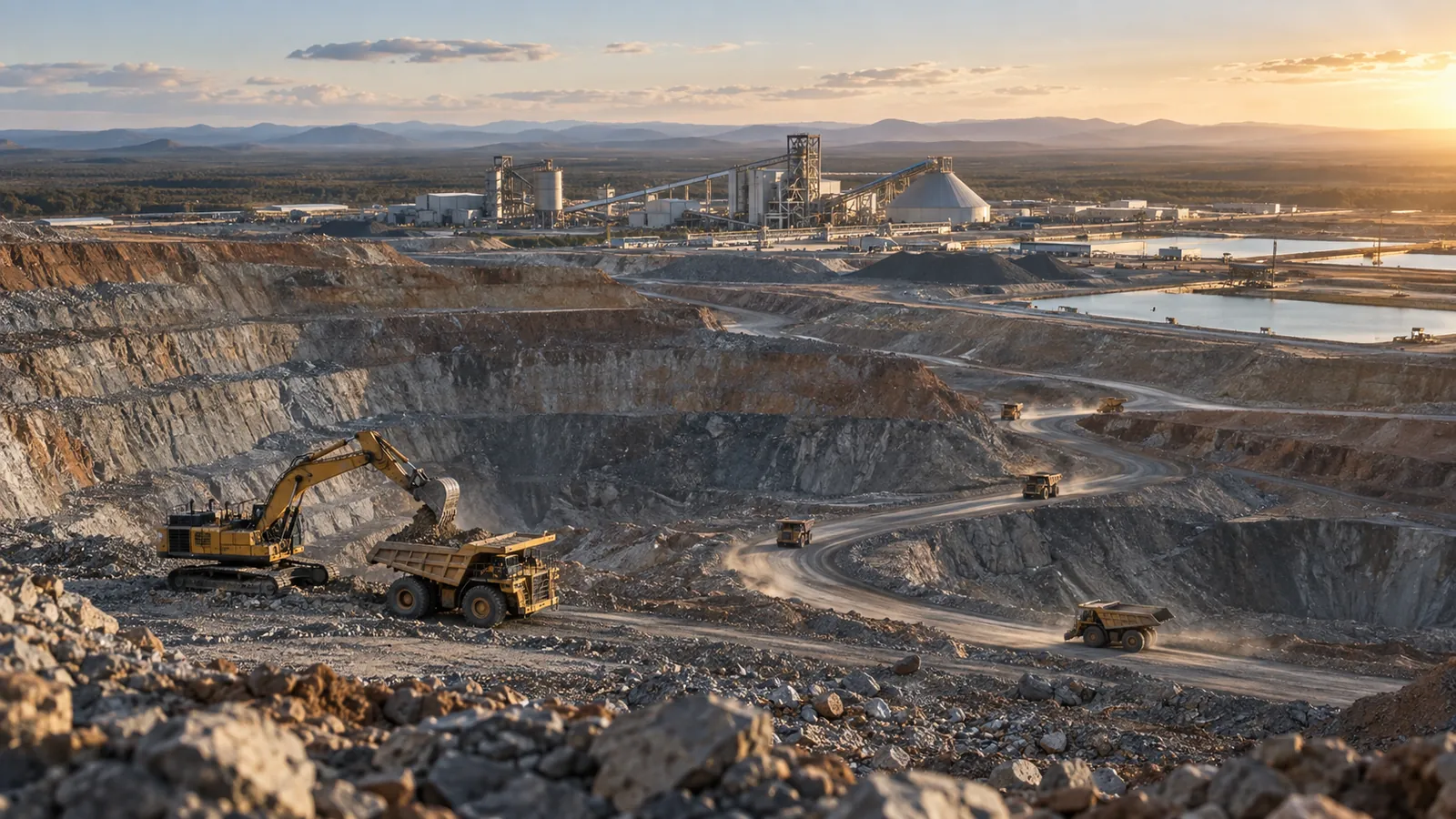
MP Materials sold 1,006 tonnes of separated neodymium-praseodymium products in the second quarter, 127% more than a year earlier, as the US rare-earth producer expanded output at Mountain Pass and moved further into downstream manufacturing. The sales ramp was substantial. But the quarter's improved non-GAAP earnings also reflected government-linked price protection, complicating any simple reading of the result as a self-sustaining profitability breakthrough. 34
Consolidated revenue rose 89% to $108.5 million from $57.4 million a year earlier. NdPr production climbed 41% to 840 tonnes, while reported sales reached 1,006 tonnes. Materials-segment revenue was $95.6 million, including $94.4 million from NdPr oxide and metal; the business generated another $17.6 million of price-protection agreement income, accounted for separately from reported revenue. MP reported combined consolidated revenue and price-protection income of $126.1 million. 34
Adjusted EBITDA improved to $28.5 million from a $12.5 million loss a year earlier. That measure included the benefit of the $17.6 million price-protection income. Subtracting the income mechanically would leave roughly $10.9 million, but that is not a company-reported adjusted EBITDA figure and should not be treated as a formal reconciliation or as proof of what the business would earn absent the agreement. Costs, pricing and contracts may change together. The comparison nevertheless shows the importance of policy-backed pricing to the reported margin recovery. 34
On a GAAP basis, MP recorded a $20.3 million net loss, or $0.11 per diluted share, compared with a $30.9 million loss, or $0.19 per share, a year earlier. Its adjusted net loss narrowed to $2.1 million, equivalent to $0.01 per diluted share. The $0.01 adjusted loss should not be confused with the $0.11 GAAP loss. These differences matter for investors comparing operating progress with the company's actual bottom-line result. 34
The difference between sales volume and production is also not sufficient on its own to quantify inventory depletion. MP's disclosed NdPr volume metrics cover separated products and its segment reporting includes sales within the group that are eliminated on consolidation. The company's production, sales and intercompany reporting therefore need to be read alongside the formal reconciliations rather than inferred solely from the 1,006-tonne and 840-tonne headline numbers. 34
MP also disclosed a long-term offtake agreement for separated gadolinium with an American aerospace and defense customer, widening its commercial product mix beyond NdPr. Its Magnetics Segment produced $16.5 million of revenue and $7.5 million of adjusted EBITDA as MP advanced customer qualification work and its manufacturing expansion. An agreement and qualification progress do not themselves establish sustained delivered volumes or profitability at full scale. 34
The investment question is increasingly precise: can MP convert rising separated-oxide sales and early downstream activity into margins that persist beyond contracted price support, while funding manufacturing growth? The second-quarter disclosures establish stronger commercial throughput and improving adjusted results, but not yet positive GAAP earnings. Future segment cost data, actual magnet deliveries and the contribution of price-protection payments will be more informative than another isolated percentage increase in NdPr sales. 34
Consolidated revenue rose 89% to $108.5 million from $57.4 million a year earlier. NdPr production climbed 41% to 840 tonnes, while reported sales reached 1,006 tonnes. Materials-segment revenue was $95.6 million, including $94.4 million from NdPr oxide and metal; the business generated another $17.6 million of price-protection agreement income, accounted for separately from reported revenue. MP reported combined consolidated revenue and price-protection income of $126.1 million. 34
Adjusted EBITDA improved to $28.5 million from a $12.5 million loss a year earlier. That measure included the benefit of the $17.6 million price-protection income. Subtracting the income mechanically would leave roughly $10.9 million, but that is not a company-reported adjusted EBITDA figure and should not be treated as a formal reconciliation or as proof of what the business would earn absent the agreement. Costs, pricing and contracts may change together. The comparison nevertheless shows the importance of policy-backed pricing to the reported margin recovery. 34
On a GAAP basis, MP recorded a $20.3 million net loss, or $0.11 per diluted share, compared with a $30.9 million loss, or $0.19 per share, a year earlier. Its adjusted net loss narrowed to $2.1 million, equivalent to $0.01 per diluted share. The $0.01 adjusted loss should not be confused with the $0.11 GAAP loss. These differences matter for investors comparing operating progress with the company's actual bottom-line result. 34
The difference between sales volume and production is also not sufficient on its own to quantify inventory depletion. MP's disclosed NdPr volume metrics cover separated products and its segment reporting includes sales within the group that are eliminated on consolidation. The company's production, sales and intercompany reporting therefore need to be read alongside the formal reconciliations rather than inferred solely from the 1,006-tonne and 840-tonne headline numbers. 34
MP also disclosed a long-term offtake agreement for separated gadolinium with an American aerospace and defense customer, widening its commercial product mix beyond NdPr. Its Magnetics Segment produced $16.5 million of revenue and $7.5 million of adjusted EBITDA as MP advanced customer qualification work and its manufacturing expansion. An agreement and qualification progress do not themselves establish sustained delivered volumes or profitability at full scale. 34
The investment question is increasingly precise: can MP convert rising separated-oxide sales and early downstream activity into margins that persist beyond contracted price support, while funding manufacturing growth? The second-quarter disclosures establish stronger commercial throughput and improving adjusted results, but not yet positive GAAP earnings. Future segment cost data, actual magnet deliveries and the contribution of price-protection payments will be more informative than another isolated percentage increase in NdPr sales. 34
Related Projects
San Bernardino County, California, United States
Mountain Pass is MP Materials' rare earth mine and processing site in California and is the only rare earth mining and processing site of scale in North America.
Loading project location…
Open location Fort Worth, Texas, United States
MP Materials is building its Independence facility in Fort Worth for alloy, magnet precursor and finished NdFeB magnet manufacturing, supporting downstream magnet supply.
Loading project location…
Open location