Honda Backs Niron as 1,500-Tonne Rare-Earth-Free Magnet Plant Takes Shape
MiningSep 30, 2026
Honda Motor Co. has invested in Niron Magnetics as the U.S. developer moves its rare-earth-free permanent-magnet technology toward commercial scale at a 1,500-tonne-a-year plant in Sartell, Minnesota. The investment amount was not disclosed, and neither company has announced a Honda offtake agreement or vehicle program. The more useful signal is that an automaker is backing the technology while Niron moves a defined manufacturing asset toward a 2027 start.1
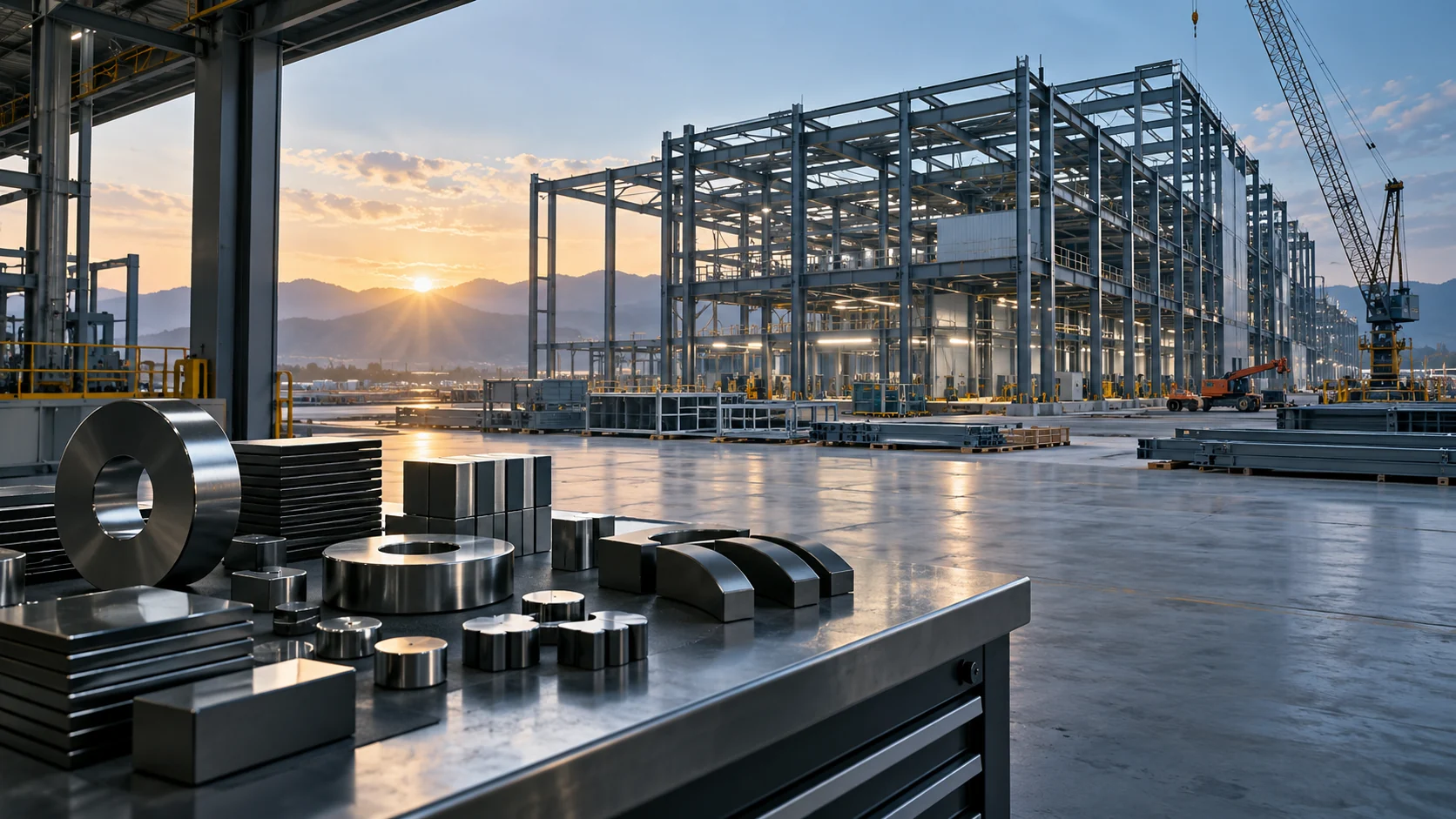
Niron marked steel raising at Sartell on Sept. 10, one day after announcing Honda's investment. The company says the 287,000-square-foot facility will be operational in 2027, employ 175 people and, at full operations, manufacture as much as 1,500 tonnes of iron-nitride permanent magnets annually.1 That makes the project materially more concrete than a laboratory-scale substitute story: capacity and an operating year are now disclosed, even though commissioning, utilisation and qualified customer volumes remain unproven.
The technology matters because Niron is attempting to remove rare earths from the permanent-magnet bill of materials rather than diversify where rare-earth oxides, metals or alloys are produced. Its magnets use iron nitride, built around abundant iron and nitrogen. If the material can meet automotive requirements at scale, it offers a fundamentally different route around neodymium-praseodymium and heavy-rare-earth exposure than building another mine, separation plant or NdFeB factory.
Honda's involvement does not establish that outcome. Niron said the investment came through Honda Xcelerator Ventures and would support commercialization and manufacturing scale-up. The announcement did not disclose the investment amount, magnet pricing, qualification status, purchase volumes or a binding supply contract.1 For investors tracking NdFeB demand, that distinction is important: strategic capital from an automaker is evidence of industrial interest, not evidence that an existing traction-motor program has switched magnet chemistry.
Niron is also assembling a sizeable financing stack around Sartell. In August it announced a $150 million loan from the Shakopee Mdewakanton Sioux Community for construction, equipment and operational readiness.2 Separately, the U.S. Office of Strategic Capital made a conditional commitment for a direct loan of up to $150 million with a 20-year term to support construction and equipment.3 The federal commitment remains conditional and should not be treated as equivalent to funded cash.
The plant itself has been developing for longer than the Honda announcement suggests. Niron broke ground on the 1,500-tonne-a-year facility in September 2025 and has previously received a $52.2 million Section 48C advanced-energy tax credit and a $10 million Minnesota Forward Fund award.45 Honda therefore joins a project that already has land, construction progress and multiple public and private funding sources rather than financing an early-stage research program from scratch.
The commercial question now shifts from whether Niron can announce a factory to whether that factory can make magnets consistently enough for demanding customers. Automotive traction motors impose requirements around coercivity, thermal stability, corrosion resistance, mechanical integrity and repeatability. A material with attractive magnetic properties still has to survive component design, manufacturing validation and customer qualification before it can displace an incumbent magnet system.
That is why the Honda investment is strategically interesting without yet being a direct threat to current rare-earth demand. Sartell gives Niron a disclosed route to 1,500 tonnes of annual capacity, and Honda gives the technology a credible automotive backer. The next evidence that matters is operating evidence: commissioning in 2027, production yield, customer qualification, utilisation and binding commercial orders. If those arrive, iron nitride could begin to compete with NdFeB in selected applications. Until then, Honda's investment is best read as an option on a rare-earth-free magnet platform rather than proof that automotive magnet demand has already shifted.
Niron marked steel raising at Sartell on Sept. 10, one day after announcing Honda's investment. The company says the 287,000-square-foot facility will be operational in 2027, employ 175 people and, at full operations, manufacture as much as 1,500 tonnes of iron-nitride permanent magnets annually.1 That makes the project materially more concrete than a laboratory-scale substitute story: capacity and an operating year are now disclosed, even though commissioning, utilisation and qualified customer volumes remain unproven.
The technology matters because Niron is attempting to remove rare earths from the permanent-magnet bill of materials rather than diversify where rare-earth oxides, metals or alloys are produced. Its magnets use iron nitride, built around abundant iron and nitrogen. If the material can meet automotive requirements at scale, it offers a fundamentally different route around neodymium-praseodymium and heavy-rare-earth exposure than building another mine, separation plant or NdFeB factory.
Honda's involvement does not establish that outcome. Niron said the investment came through Honda Xcelerator Ventures and would support commercialization and manufacturing scale-up. The announcement did not disclose the investment amount, magnet pricing, qualification status, purchase volumes or a binding supply contract.1 For investors tracking NdFeB demand, that distinction is important: strategic capital from an automaker is evidence of industrial interest, not evidence that an existing traction-motor program has switched magnet chemistry.
Niron is also assembling a sizeable financing stack around Sartell. In August it announced a $150 million loan from the Shakopee Mdewakanton Sioux Community for construction, equipment and operational readiness.2 Separately, the U.S. Office of Strategic Capital made a conditional commitment for a direct loan of up to $150 million with a 20-year term to support construction and equipment.3 The federal commitment remains conditional and should not be treated as equivalent to funded cash.
The plant itself has been developing for longer than the Honda announcement suggests. Niron broke ground on the 1,500-tonne-a-year facility in September 2025 and has previously received a $52.2 million Section 48C advanced-energy tax credit and a $10 million Minnesota Forward Fund award.45 Honda therefore joins a project that already has land, construction progress and multiple public and private funding sources rather than financing an early-stage research program from scratch.
The commercial question now shifts from whether Niron can announce a factory to whether that factory can make magnets consistently enough for demanding customers. Automotive traction motors impose requirements around coercivity, thermal stability, corrosion resistance, mechanical integrity and repeatability. A material with attractive magnetic properties still has to survive component design, manufacturing validation and customer qualification before it can displace an incumbent magnet system.
That is why the Honda investment is strategically interesting without yet being a direct threat to current rare-earth demand. Sartell gives Niron a disclosed route to 1,500 tonnes of annual capacity, and Honda gives the technology a credible automotive backer. The next evidence that matters is operating evidence: commissioning in 2027, production yield, customer qualification, utilisation and binding commercial orders. If those arrive, iron nitride could begin to compete with NdFeB in selected applications. Until then, Honda's investment is best read as an option on a rare-earth-free magnet platform rather than proof that automotive magnet demand has already shifted.
Related Project
Sartell Iron Nitride Magnet Plant
NIRON | plant
Minnesota, United States
Niron's first commercial-scale Iron Nitride permanent-magnet manufacturing plant in Sartell, Minnesota. The company marked steel raising in September 2026 and says the 287,000-square-foot facility is expected to be operational in 2027,…
Loading project location…
Open location