Stibnite’s $2.9 Billion EXIM Loan Still Awaits Drawdown as Construction Advances
MiningOct 5, 2026
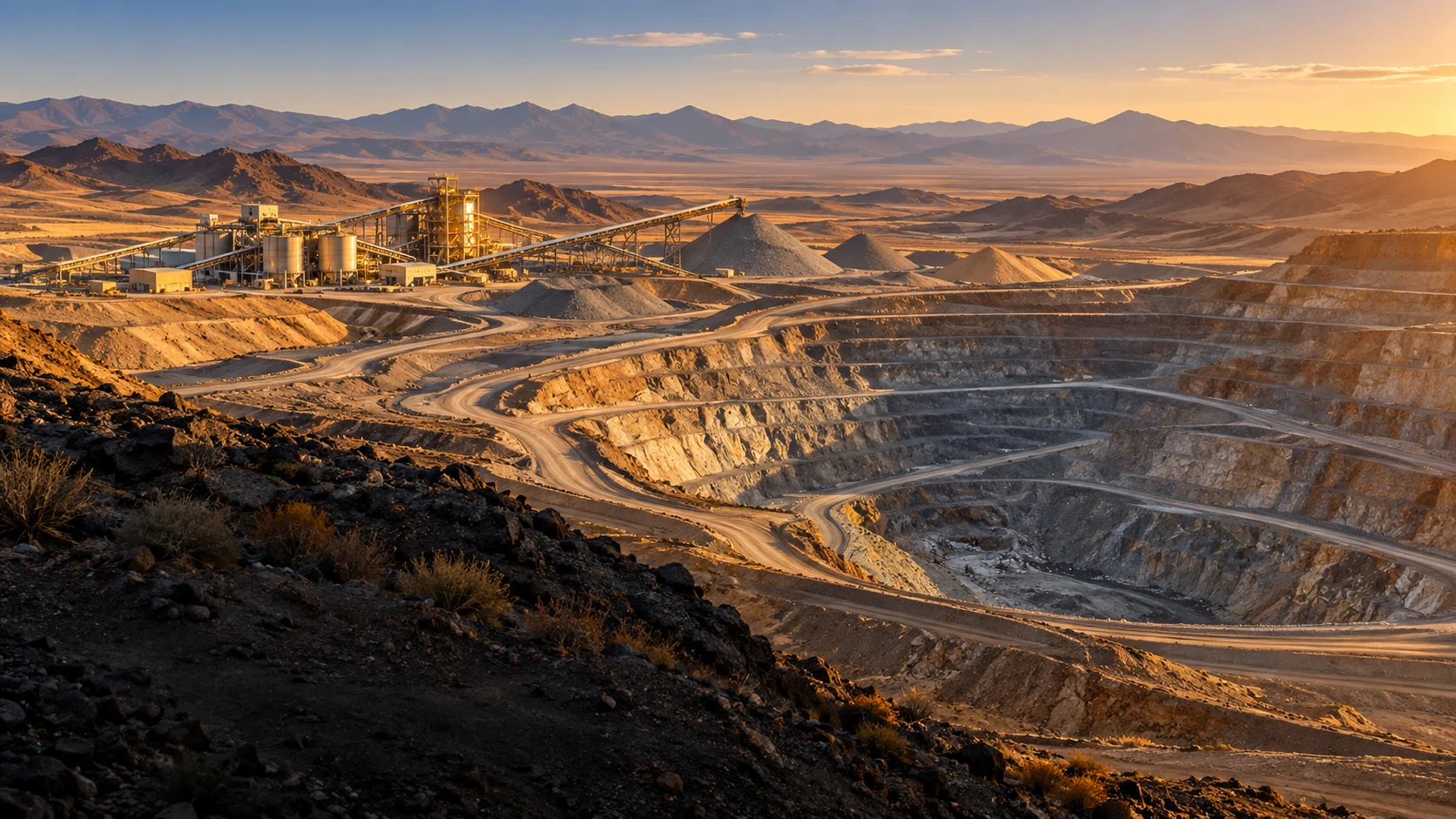
AI-generated illustration of an open-pit gold operation; not a photograph of the Stibnite project.
Perpetua Resources has removed much of the financing uncertainty around its Stibnite gold-antimony project in Idaho, but not the final drawdown risk. The Export-Import Bank of the United States approved a $2.9 billion senior secured loan in May, a package that Perpetua says, together with cash on hand, is expected to cover the project’s estimated direct construction cost.3
The structure matters more than the headline number. The 13-year facility comprises about $2.4 billion available upfront, with the balance earmarked for capitalised construction interest and EXIM’s exposure fee. Perpetua’s December 2025 technical report put estimated project capital at about $2.58 billion. That means the $2.9 billion headline should not be read as $2.9 billion of cash available for mine construction.
Nor is Board approval the same as funded debt. Perpetua said availability remains subject to definitive documentation and customary conditions precedent. The company expected those steps in the second half of 2026.3 For investors, that makes loan closing and drawdown the financing milestones that matter now, rather than another restatement of EXIM’s May approval.
Stibnite is meanwhile moving beyond a paper development project. Perpetua began early works in October 2025 and in late May 2026 started additional work on the Burntlog Route, alongside worker housing, selected power-line upgrades and drilling. The company said those activities are intended to preserve a schedule for gold and antimony production in 2029.6
That construction progress changes the risk profile. The central question is no longer whether Stibnite can obtain a large named lender. It is whether Perpetua can convert the approved facility into available capital while detailed engineering, procurement and site works consume cash. A delay in documentation would not erase the EXIM commitment, but it could complicate the sequencing of full-scale construction and increase reliance on the company’s own liquidity.
Gold provides most of the project’s economics, while antimony explains much of its strategic value to Washington. Stibnite contains what Perpetua identifies as the only reported U.S. reserve of antimony, a mineral used in defence and industrial applications. The company’s updated technical work describes 4.8 million ounces of gold reserves and a project designed to produce both gold and antimony. That combination has allowed a conventional mine-development case to attract unusually large U.S. government financing support.3
The distinction is important for valuation. EXIM approval materially reduces funding risk, but it does not remove construction, commissioning or commodity-price risk. Stibnite still has to turn a multibillion-dollar capital programme into a functioning pressure-oxidation operation, ramp mining and processing, and deliver saleable gold and antimony products on schedule. Early works are evidence of execution; they are not yet evidence that the full plant can be built and commissioned to budget.
The next useful financing disclosure is therefore not another description of the $2.9 billion approval. It is confirmation that definitive loan documents are complete, conditions precedent have been satisfied and the facility is available for drawdown. Until then, Stibnite sits in an unusual middle ground: critical-path construction is underway and the principal lender has approved the debt, but the final bridge between those two facts still has to close.
Related Project
Stibnite Gold Project
PPTA | deposit
Idaho / Valley County, United States
Perpetua Resources' flagship Stibnite project in central Idaho, designed to redevelop a historic mining district for gold and antimony production while undertaking environmental restoration.
Loading project location…
Open location