Aclara’s Louisiana Permit Clears a Gate; $277 Million Dynamo Still Needs Funding
MiningOct 6, 2026
South America | United States
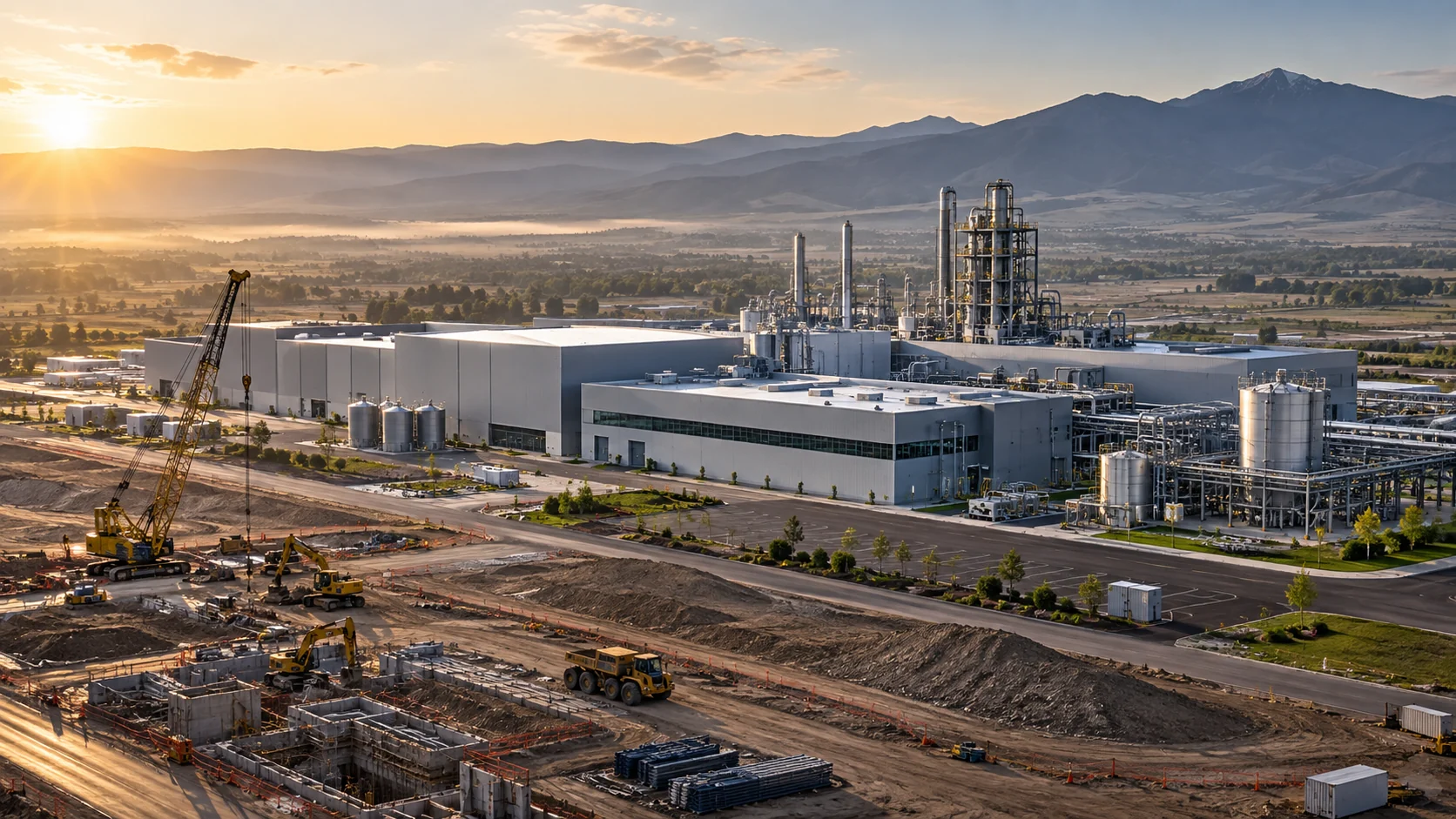
AI-generated illustration of industrial plant construction; not a photograph of Project Dynamo.
Aclara Resources has secured Louisiana’s main air permit for Project Dynamo, removing one of the clearest regulatory hurdles to construction of its planned rare-earth separation plant at the Port of Vinton. The Louisiana Department of Environmental Quality approved State Permit No. 0520-00550-00 on September 14, authorizing construction and operation subject to the plant’s permitted emission sources, limits, controls and operating requirements. 4
The permit matters because Aclara is no longer waiting on a preliminary air-quality decision before it can move the project toward a build. Hatch is completing the final stages of basic engineering, and Aclara is targeting a first-quarter 2027 groundbreaking. That timetable is still conditional: the company says construction will proceed subject to securing the required financing. 4
That financing question is more important than the permit headline for investors. Aclara has previously put the separation plant’s capital requirement at about US$277 million. The facility is designed to produce magnet-grade neodymium-praseodymium, dysprosium and terbium oxides, with average annual output at full capacity of about 1,131 tonnes of NdPr oxide, 148 tonnes of dysprosium oxide and 25 tonnes of terbium oxide. 5
The project has attracted U.S. policy support, but that support should not be confused with committed project finance. On September 4, the Export-Import Bank of the United States issued Aclara a non-binding Letter of Interest indicating willingness to consider up to US$750 million of financing with a tenor of as much as 15 years. That potential package relates to a broader Project Dynamo scope that includes separation, metals and alloys, not simply the US$277 million separation plant. 6
This distinction is central to the investment case. A permit resolves a regulatory risk; a Letter of Interest signals potential lender appetite. Neither, by itself, funds construction. Aclara still has to translate its engineering work, feed strategy, product qualification and government support into a bankable capital structure before the Louisiana schedule becomes executable.
The operating proposition is nevertheless becoming more defined. Aclara plans to feed Project Dynamo with rare-earth carbonate from its ionic-clay projects in South America and produce individual oxides for permanent-magnet markets. Its current platform links the Carina project in Brazil and Penco in Chile with U.S. separation, while additional downstream metals and alloys capacity is planned at the Louisiana site. 5
That vertical integration creates both strategic value and technical risk. The plant is intended to handle chemically variable feed from different deposits while maintaining high-purity output and stable solvent-extraction performance. At commercial scale, recovery, impurity control, reagent consumption and product qualification will matter as much as nominal nameplate capacity.
The next milestones are therefore narrower than the usual supply-chain narrative. Investors should watch for a defined financing package, completion of basic and subsequent detailed engineering, evidence that Aclara can qualify its oxide products at commercial specifications, and a formal notice to proceed or groundbreaking. The air permit improves the odds that Project Dynamo can be built; the financing package will determine whether it actually is.
Related Project
Project Dynamo
ARA | plant
Port of Vinton, Calcasieu Parish, Louisiana, United States
Aclara Resources planned commercial rare-earth separation facility on an 82-acre Louisiana Economic Development certified site at the Port of Vinton. The separation plant carries an estimated US$277 million investment and is designed to…
Loading project location…
Open location